
Murray Irrigation
Fee structure Review 2026 - FAQs

1. What changes in the fee structure are being proposed?
The proposed solution simplifies the company’s fee structure[1]. It involves moving to a variable water delivery fee and cost recovery for outlet fees. The proposed fee structure will improve equity, reduce fixed costs and reduce or maintain average cost for around 80% of customers.
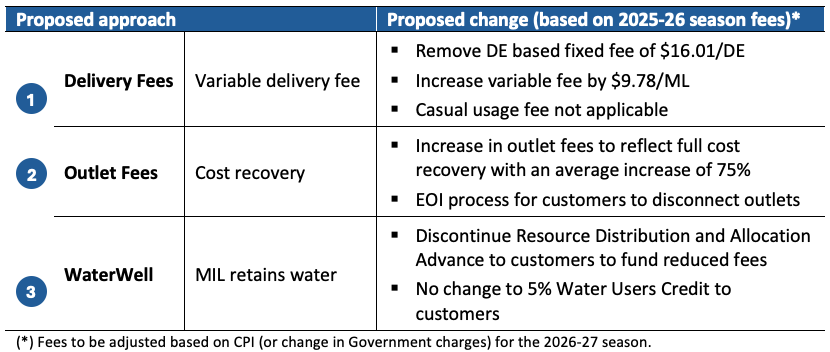
[1] Major customer fees paid by irrigators. Based on 2025-26 fees. Excludes charges collected on behalf of the Government.
2. Why is the company proposing this change?
In response to commentary from customers that the fixed fees associated with Delivery Entitlements have led to inequitable cost outcomes, Murray Irrigation undertook a comprehensive independent review of its fee structure and developed a proposed solution for customer feedback. The proposed solution is more equitable for customers and:
- Reduces cost or maintains cost for around 80% of customers,
- Simplifies the company’s fee structure to better align with the customer’s business,
- Reduces fixed costs and better aligns customer costs to their income cycles, and
- Rewards water use.
To understand how this change would impact your individual farm business, please login to your customer portal and utilise the Customer Calculator. This calculator has been developed to demonstrate what effect the proposed fee structure would have had on customer costs based on your average and past water use.
3. What problem is the proposed fee structure trying to fix?
Murray Irrigation’s fee structure, implemented in 2007, has become inequitable and is no longer fit for purpose as a result of the separation of Water Entitlements (WEs) from land and the resultant issuing of Delivery Entitlements (DEs), and government water buybacks. This has caused DEs to fall out of alignment with actual water use and led to:
Large variation in cost paid by customers with similar water use
Some customers are paying up to four times more than others for similar water use. This is primarily due to DEs fees being a fixed cost and the misalignment of DEs to WEs. This variation in cost is shown in the graph below that compares each customer’s average cost[1] to their average use of water.
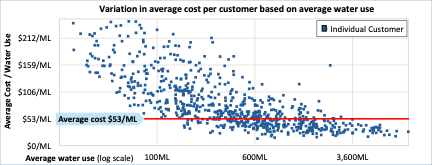
[1] Major customer fees paid by irrigators. Based on 2025-26 fees. Excludes charges collected on behalf of the Government.
High fixed cost
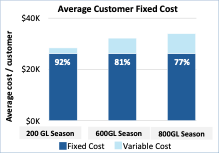
Currently, 81% of the average fees paid by customers are fixed and do not vary with water use. While these fees recover MIL’s fixed operating and maintenance costs, it does not provide the flexibility customers are seeking, particularly during low water allocation years.
Under-recovery of outlet costs
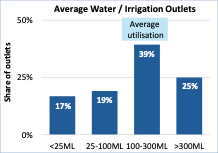
Murray Irrigation's independent review also found that current outlet fees significantly under‑recovers operating and future refurbishment costs, creating a long‑term capital funding gap. This also distorts price signals to retain or disconnect outlets.
4. What/who caused this problem?
The irrigation landscape has undergone significant change since Murray Irrigation’s current fee structure was established in 2007. This includes:
- Separation of land and water
- Government water buybacks
- Land consolidation
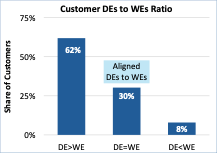
These changes have led to 70% of customers having a misaligned DE and WE structure, driving a large variation in delivery cost based on water use between customers.
5. How did Murray Irrigation arrive at this solution?
When developing the proposed solution, Murray Irrigation was guided by 4 principles:
- Improve equity and cost alignment
- Reward water use
- Minimise negative impact
- Maintain the company’s financial stability.
The proposed fee structure meets these principles and follows extensive expert analysis and modelling.
6. Why is addressing cost inequity important for long-term stability for customers, the company and the broader community?
Customers have raised concerns that the current fee structure produces inequitable outcomes, with some paying up to four times more than others for similar water use. Addressing these issues is essential to restoring fairness and ensuring that fees better reflect how water is used across the footprint.
Improving cost equity also supports more efficient and productive water use, which is critical for the long‑term health of the irrigation network and the broader region. When costs better match water use, customers have clearer signals to manage their operations efficiently, leading to a stronger, more sustainable system.
7. Why is the company proposing to implement this change so quickly on 1 July 2026?
Weather models are predicting a dry cycle and low water allocation season ahead. By implementing this change on 1 July 2026, the majority of customers will benefit from lower fixed fees.
8. Has the Board already made a decision on whether to proceed with the proposed change?
No. The Murray Irrigation Board is seeking customer feedback before making a decision. A Board meeting is being held at the end of April. At this time, Directors will make a decision on whether to proceed with the suggested change to the company’s fee structure, or to maintain the status quo and stay with the current fee structure.
9. Has the company looked at ways to add value to the DE?
DEs were issued to customers when water was separated from land in 2007. Since then, government water buybacks, land consolidation and other external factors have skewed the equal ratio of DEs and WEs causing 70% of customers to have a misalignment in their DE and WE structure.
When commencing this review, it quickly became clear that for most customers DEs represent a cost in terms of fixed delivery fees regardless of water use and/or a potential liability if a customer sells their farmland. This cost and potential liability could increase over time with changes in water ownership and land use by customers.
The Murray Irrigation Board believes the best option to mitigate this cost and potential liability for customers is not using DEs to determine fees and water allocations. DEs held will be retained for shareholder voting as per the Company Constitution.
10. Have you considered other fee structure options to address this?
Yes. Independent experts have undertaken extensive modelling and assessment of various fee restructure options. These have included consideration of models that retained the use of DEs to determine fixed water delivery fees. Several options were considered by the Board, with the proposed fee structure shared today determined to best meet the following four principles:
Improve equity
Reduce variability in cost between customers with a similar water use, by variabilising cost and reducing fixed costs.
Reward water use
Reward customers with higher water use, by retaining volume tiers for delivery fees and scale benefits with higher outlet use.
Minimise negative impact
Limit the number of customers who are negatively impacted, by reducing fees.
Company financial security
Maintain company earnings to support services and maintain infrastructure, by continuing to diversify revenue that include increasing earnings from the sale of water to customers.
11. What will be the fees I pay if the proposed fee structure is implemented?
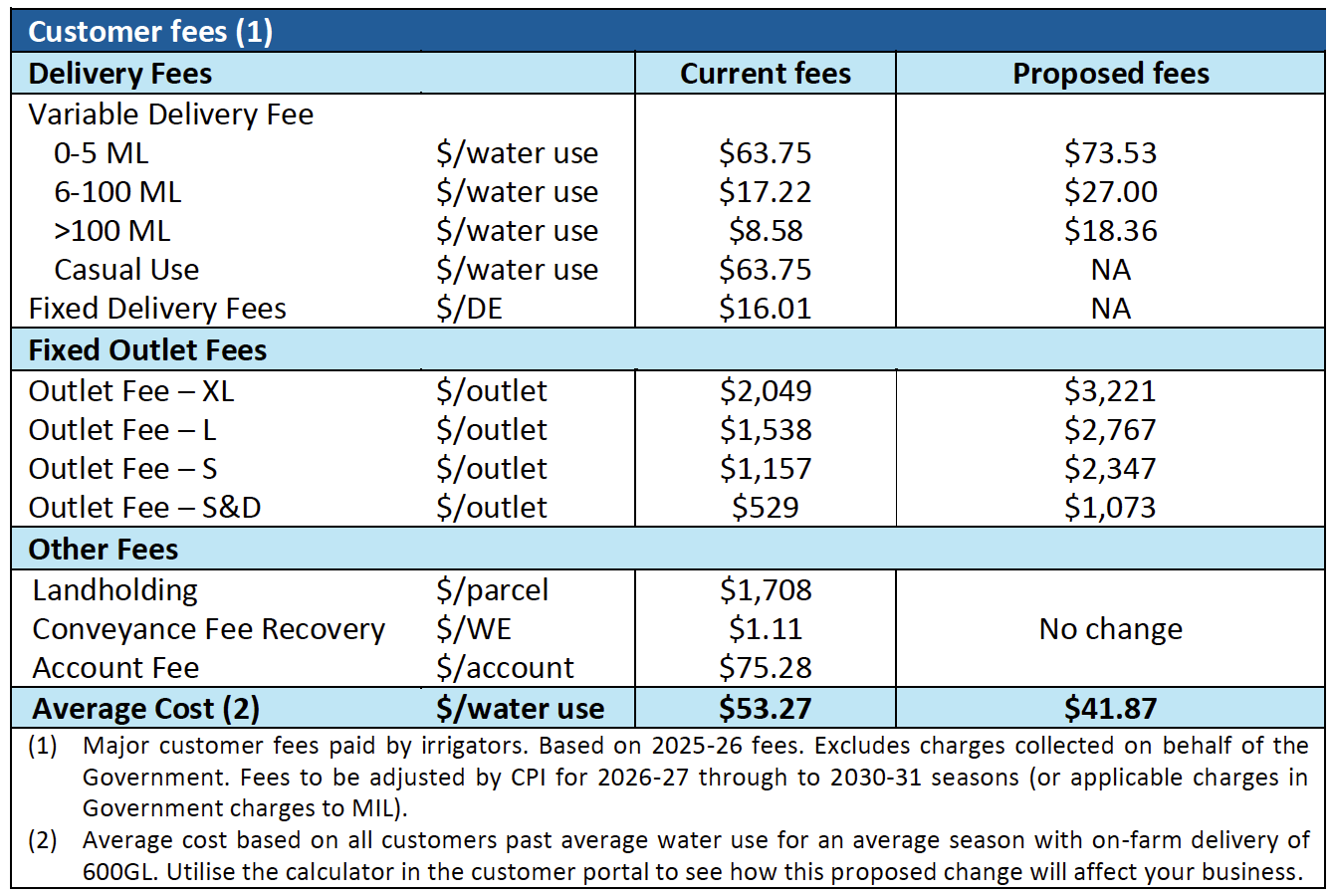
The below table compares the proposed new fee structure against the current fee structure based on 2025-26 fees. These fees will be adjusted by CPI (or if applicable by the change in Government charges) for the 2026-27 season through to the 2030-31 season. Murray Irrigation will continue to pass through government charges at cost.
To understand how this change would impact your individual farm business, please login to your customer portal and utilise the Customer Calculator. This calculator has been developed to demonstrate what effect the proposed fee structure would have had on customer costs based on your average and past water use.
12. How will customers benefit from the proposed fee structure?
The proposed fee structure better aligns costs for customers with similar water use. Most customers will see lower costs, while those who use more water are rewarded.
The proposed fee structure delivers the following net benefits to customers:
Reduced average cost
21% (or $11.40/ML) reduction in average cost for customers. The change in average cost for each customer will depend on their DEs held to water use and outlet utilisation, where cost is expected to be:
- Reduced for 66% of customers,
- Similar for 17% of customers (+/-$1,000), and
- Increased for 17% of customers (those with low DEs to Water Use and/or Outlet Use)
Improved equity
50% reduction in the variation of cost between customers with a similar use of water. Customers will gain more control in the fees paid, with around 85% of average cost determined by the customer’s water use and number of outlets.
Reduced fixed cost
Portion of average fixed cost will reduce from 81% to 53%. This will deliver increased cost savings to customers in low water allocation seasons, with a 38% reduction in average cost vs 21% in an average season.
DEs will not be a liability
Not using DEs to determine delivery fees will remove a potential liability if a customer sells or buys farmland or changes land use, as DE Termination fees will not be relevant.
Important note: No WaterWell distributions
Murray Irrigation will retain the water from the Resource Distribution and Allocation Advance that has been previously allocated to customers by DEs. This is expected to recover 50% of the reduced revenue from customer fees.
Reward water use
Customers will continue to receive the 5% Water User Credit based on annual water use.
To understand how this change would impact your individual farm business, please login to your customer portal and utilise the Customer Calculator.
13. How are the Board's Member Directors impacted by this change?
The Member Directors have used the Customer Calculator to determine their change in cost with the proposed fee structure. The average reduction in cost for the Member Directors is 12%, which is less than the average 21% reduction for all customers.
14. Will there be transition support or a phase-in period?
If the Board resolves to implement the proposed fee structure, it will be implemented on 1 July 2026, effective for the 2026-27 season onwards. Following implementation, an expression of interest (EOI) to gauge customer appetite to disconnect outlets will occur later in the year.
15. I’m happy to pay higher fees and keep WaterWell. Am I able to do this?
No. If the Board resolves to implement the proposed fee structure, Murray Irrigation will retain and sell the water that has to date been allocated to Allocation Advance and Resource Distribution. This is expected to recover 50% of the average $6.8 million in reduced company revenue from customer fees.
Irrigation customers will continue to receive a 5% Water Users Credit.
16. I am negatively impacted by this. Who can I speak to?
While around 80% of customers will see a decrease or little to no change in their average annual costs, around 20% of customers will see an average increase of more than $1,000.
If you wish to discuss how this proposed change impacts your business, please contact the Customer Experience team on 1300 138 265
17. Why is WaterWell being removed and Murray Irrigation retaining this water?
If the Board resolves to implement the proposed new fee structure, Murray Irrigation will take on a significantly larger financial burden by absorbing the reduced and more variable revenue from customer fees. To maintain financial stability while keeping fees affordable, the company must continue diversifying its revenue streams, including selling water through Water Solutions.
By retaining and selling the water currently allocated to Allocation Advance and Resource Distribution, Murray Irrigation expects to recover around 50% of the average $6.8 million reduction in company revenue that results from lowering customer fees. This is essential for maintaining services, protecting infrastructure, and ensuring long‑term financial sustainability.
18. How will the proposed fee structure affect Murray Irrigation's revenue?
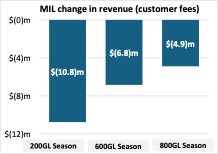
In an average 600GL water delivery season, the company will need to manage a reduced revenue of $6.8 million from customer fees. In a low 200GL season the reduction of revenue will be $10.8 million and in a high 800GL water delivery season the reduction of revenue will be $4.9 million.
19. How is the company going to remain viable during low water allocation seasons?
To maintain earnings and manage variable revenue through the cycle, Murray Irrigation will continue to diversify its revenue streams through other sources including, but not limited to:
- Retaining and selling available company water from the Allocation Advance and Resource Distribution. This is expected to recover 50% of the average $6.8 million in reduced company revenue from customer fees; and
- Continuing to attract new water to the footprint as demonstrated by the CEWO and MDBA projects.
20. How do these changes impact the shareholding structure of Murray Irrigation?
If the Board resolves to implement the proposed fee structure, there will be no impact to the shareholding structure of Murray Irrigation. DEs held will be retained as per the Company Constitution.
21. Are there plans to change the shareholding structure and, if so, when?
The proposed fee structure, including not using DEs to determine the water delivery fee, will have no impact on the shareholding structure, as this is determined by the Company’s Constitution. As highlighted in the strategic plan, the shareholding structure is a focus area the Board is looking into. There is not a timeline set for this focus area at present. Any change to the Company’s shareholding structure will require approval from a minimum 75% of shareholders.
22. What should I do with my DEs?
If the Board approves the proposed fee structure, DEs will not be used for determining delivery fees and allocations under the Resource Distribution and Allocation Advance. Further information will be provided on how shareholders can manage their DEs.
23. Murray Irrigation told us that it would not change fees before 2029? Why is this happening now?
Murray Irrigation has undertaken this review of the company’s fee structure in direct response to customer feedback that the fixed delivery fees associated with Delivery Entitlements have led to inequitable cost outcomes.
The Company has moved quickly on this because weather models are pointing toward a dry cycle and low water allocation season ahead. By implementing this change on 1 July 2026, the majority of customers will benefit from lower fixed fees.
If the proposed fee structure is implemented, the proposed fees would be adjusted each year based on CPI (or change in Government charges) for the 2026-27 season through to the scheduled review in 2030-31.
24. If this change isn’t accepted, will our outlet fees be going up in 2029?
If the proposed fee structure is not approved and implemented, the current fee structure remains in place and will be adjusted each year based on CPI (and change in Government charges) for the 2026-27 season through to 2028-29.
25. Why weren't customers consulted in the initial investigative phase to come up with solutions?
Murray Irrigation undertook detailed expert modelling to understand the inequity concerns raised by customers and to identify the most effective solution. Because every customer’s business structure and water use profile is different, individual consultation during the investigative phase would not have produced a consistent or fair basis for designing a new fee structure.
Throughout this stage, our priorities were to:
- Improve cost alignment between customers with similar water use
- Reward customers with high water use
- Limit the number of customers who are negatively impacted
- Maintain the company’s financial stability.
To ensure the company met these objectives, expert consultants worked with management to develop a number of models to address the cost inequity across the footprint.
26. Why isn't there a customer vote on whether to implement the proposed change?
The division of decision-making power between the Board Directors and the shareholders is ruled by the Corporations Act 2001 (Cth) (Corporations Act) and Murray Irrigation's Constitution.
Matters to be determined by shareholders include resolutions electing Member Directors and ratifying the appointment of non-Member Directors.
Matters relating to operations, management or customer matters are to be decided by the Board of Directors. This includes the fee structure of the company.
A key theme to emerge from the Board strategy day in February 2026 was the importance of engaging with customers prior to the Board making a decision on a possible change to the company’s fees structure. Customers are encouraged to read the provided materials, and participate in the customer meetings being held between 25 March and 10 April 2026 prior to providing their feedback via online survey between 10 April and 17 April 2026.
